
Under California law, a cyclist generally has the same rights and responsibilities as a driver, and a rider hit by a vehicle can pursue the same compensation any injured motorist could. If a public roadway defect caused the crash, a written government claim is due within six months — much sooner than the standard two-year deadline.
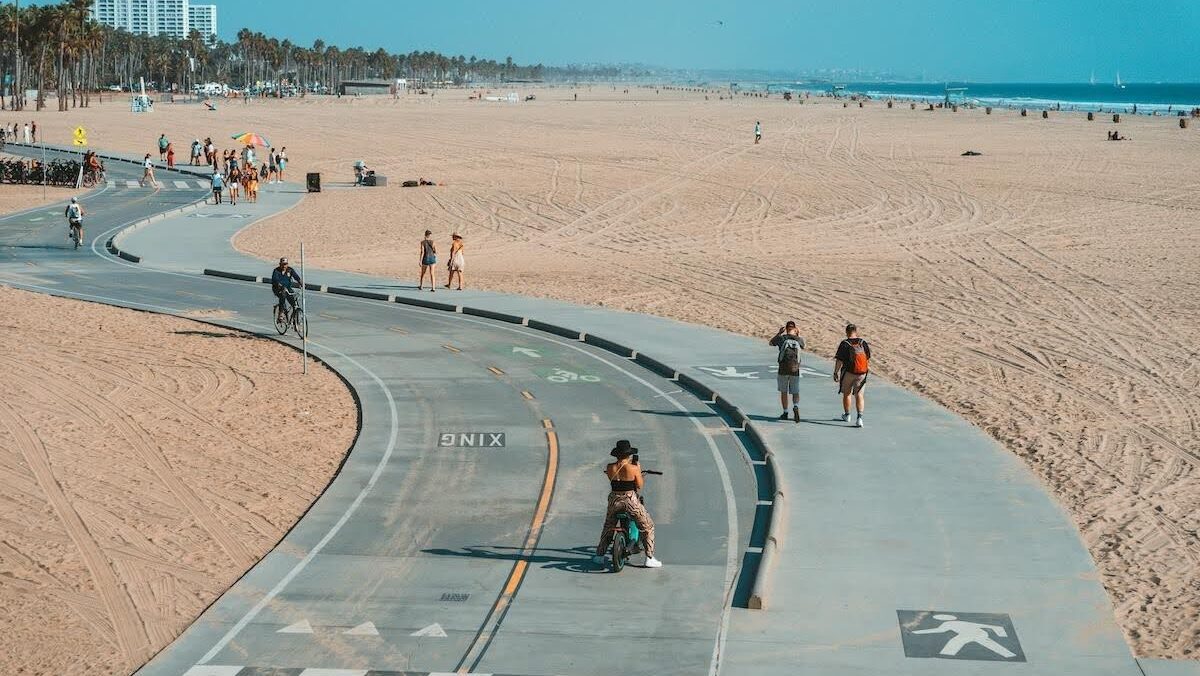
The Westside and the beach cities are built for two wheels. The Marvin Braude bike path runs the sand from Santa Monica through Marina Del Rey toward the South Bay; Culver City and Manhattan Beach have steadily added lanes and routes. More riders mean more interaction with traffic — and more collisions when that interaction goes wrong.
Do cyclists have the same rights as drivers in California?
Under California law, a person on a bicycle generally has the same rights and responsibilities as the driver of a vehicle. A cyclist struck by a car in Santa Monica is not a second-class road user with a weaker claim — they are entitled to pursue the same compensation for medical bills, lost income, and other harm that any injured motorist could. The vulnerability is physical, not legal.
In practice, a bicycle-versus-vehicle collision is handled much like other car accident cases: the question is who acted negligently, and the injured rider has every right a driver would.

What are “dooring” and “right-hook” bicycle accidents?
Two collision types recur in dense areas like Culver City and Marina Del Rey. “Dooring” happens when someone opens a car door into a cyclist’s path; the “right hook” occurs when a vehicle turns right across a cyclist traveling straight. In both, the driver’s conduct — not the cyclist’s — is typically the cause, and California’s pure comparative negligence rule (Li v. Yellow Cab Co. (1975) 13 Cal.3d 804) governs any dispute over shared fault. A cyclist found partly responsible still recovers, reduced by their percentage.
What if a pothole or bad road design caused my crash?
Sometimes the danger is a pothole, a poorly designed lane, or a defect in a path maintained by a city. When a public entity may be responsible, the six-month claim deadline under Government Code section 911.2 applies — dramatically shorter than the ordinary two-year personal injury deadline under Code of Civil Procedure section 335.1. For a cyclist injured by infrastructure in Inglewood or Manhattan Beach, recognizing the public-entity angle early is critical.
The Takeaway
Riding the Westside and beach cities is one of the genuine pleasures of life here — and the law treats cyclists as full and equal road users. If you are struck, you have the same right to recovery as any driver, your fault (if any) reduces but does not erase your claim, and — where a public roadway is involved — a much shorter deadline may apply. Because bicycle collisions so often cause severe, lasting injuries, document everything, seek care, and act within the clock that fits your case.
Frequently Asked Questions
Do cyclists have the same legal rights as drivers in California?
Generally yes. A person on a bicycle has the same rights and responsibilities as a vehicle driver, so a cyclist hit by a car can pursue the same compensation — medical bills, lost income, and pain — as any injured motorist.
What is a “dooring” accident?
Dooring happens when someone opens a parked car’s door into a cyclist’s path. The person who opened the door is typically at fault, though California’s comparative negligence rule governs any dispute over shared blame.
Can I recover if I was partly at fault for the bike crash?
Yes. Under pure comparative negligence, a cyclist found partly responsible still recovers, with the award reduced by their percentage of fault rather than eliminated.
What if a road defect caused my bicycle accident?
If a public entity is responsible for the defect, you must present a written claim within six months under Government Code section 911.2 — much shorter than the standard two-year deadline, so recognizing this early is critical.